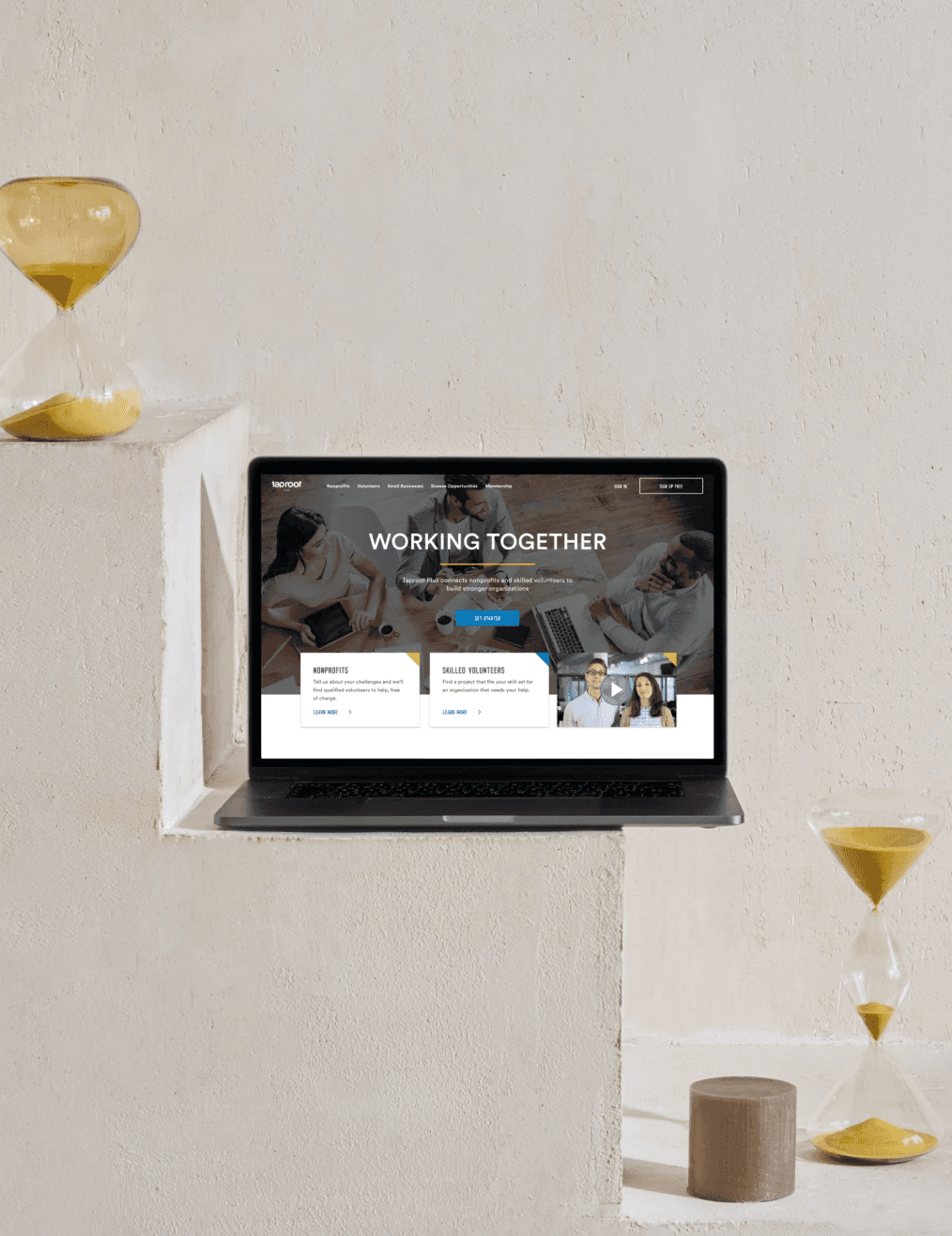
Expanding Taproot Plus
Expanding Taproot Plus
Expanding Taproot Plus
Expanding Taproot Plus
Designing a 0-to-1 product direction that opened a nonprofit pro bono platform to small businesses during COVID-19, securing a $300K investment and reaching hundreds of businesses in need.
Designing a 0-to-1 product direction that opened a nonprofit pro bono platform to small businesses during COVID-19, securing a $300K investment and reaching hundreds of businesses in need.
TIMELINE
May-September 2020
May-September 2020
RESPONSIBILITIES
Product Strategy, User Research, Interaction Design, Visual Design, Prototyping, Cross-Functional Leadership
Product Strategy, User Research, Interaction Design, Visual Design, Prototyping, Cross-Functional Leadership
MY ROLE
UX Designer (Sole Designer)
UX Designer (Sole Designer)
TEAM
Product Manager, CPO, Director of Product, Head of Marketing, Sr. Engineer
Product Manager, CPO, Director of Product, Head of Marketing, Sr. Engineer
PLATFORM
Taproot Plus (Web SaaS)
Taproot Plus (Web SaaS)
9 minutes to read
9 minutes to read
OUTCOME
The product launched, the $300,000 investment was secured, and hundreds of small businesses gained access to free professional expertise during the peak of the COVID-19 crisis, shaping Taproot's long-term direction toward serving small businesses alongside nonprofits.
CONTEXT
The Opportunity
Small businesses make up 99% of all businesses in the U.S. In 2020, nearly half faced existential threats from COVID-19. Many needed expert guidance in financial planning, marketing, and digital transformation, but hiring consultants wasn't an option.
Meanwhile, Taproot Foundation, a national nonprofit operating Taproot Plus, a pro bono platform connecting skilled professionals with organizations in need, had an opportunity to secure a $300,000 investment if it could expand the platform to serve small businesses, not just nonprofits.
This meant designing an entirely new product direction on top of existing infrastructure. Not a feature. Not an iteration. A fundamental expansion of what the platform was for, representing nearly one-third of the entire product.
PROBLEM STATEMENT
Small businesses couldn't access professional expertise. Skilled volunteers were eager to help. No bridge existed between them.
How might we bridge this gap without disrupting the existing nonprofit support model — and without alienating the volunteer community that made the platform work?
Research
APPROACH
Research first. Build trust. Then design.
Before designing a single screen, I needed to understand whether the people who powered the platform, the volunteers, would actually support this expansion
01
Research & Validation
~30 user surveys and 15 interviews with volunteers, nonprofit partners, and corporate clients to validate the expansion direction
02
Cross-Functional Alignment
Engaged Product, Engineering, and Marketing to align on a low-effort, high-impact approach leveraging existing infrastructure.
03
Design & Prototyping
Wireflows, mockups, and prototypes built on the design system I created months earlier, accelerating delivery without sacrificing quality.
04
Executive Buy-In & Launch
Presented the product direction to the COO and VP of Marketing. Secured investment. Launched.
USER RESEARCH
Volunteers said yes, with conditions.
The research surfaced a nuanced picture. Volunteers were open to supporting small businesses, but they had specific trust and transparency requirements that would need to be addressed in the product design.
01
Clear Separation Required
Volunteers did not want small business projects mixed with nonprofit projects. They needed to feel that supporting a business wasn't coming at the expense of a nonprofit that genuinely needed help.
02
Eligibility Transparency
Volunteers wanted to know exactly which small businesses would qualify, and how financial need would be assessed. Without this, trust would erode.
03
Mission Trust Intact
Despite reservations, volunteers expressed trust in Taproot's ability to handle the expansion responsibly, a signal that the direction had social license if executed thoughtfully.
FROM INSIGHT TO DECISION
Every major design decision traced back to a specific research finding.
USER CONCERN
"Don't mix small businesses with nonprofits."
DESIGN RESPONSE
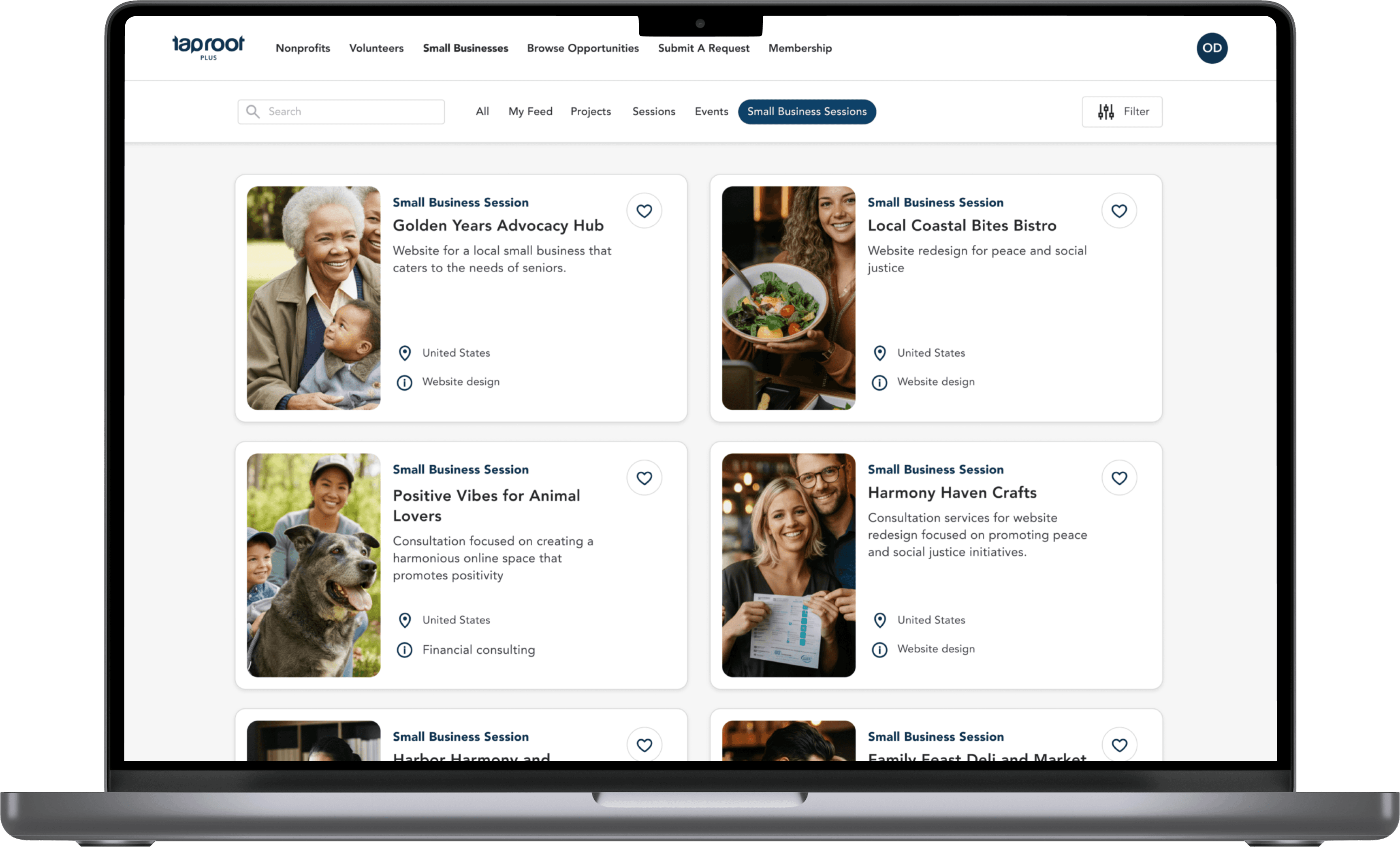
Designed a dedicated landing page for small business projects, completely separated from nonprofit listings, ensuring clear differentiation while maintaining a seamless experience within the platform.
USER CONCERN
"How do I know these businesses actually need help?"
DESIGN RESPONSE
Built detailed eligibility criteria directly into the product, surfacing exactly which types of businesses qualified and why, with transparent financial need requirements. Volunteers could verify before committing.
TEAM CONSTRAINT
"We can't build an entirely new product from scratch."
DESIGN RESPONSE
Adapted the existing nonprofit application flow, modular components from the design system I had built months earlier, ensuring consistency, reducing engineering effort, and accelerating delivery.
PROCESS
Understanding the new user
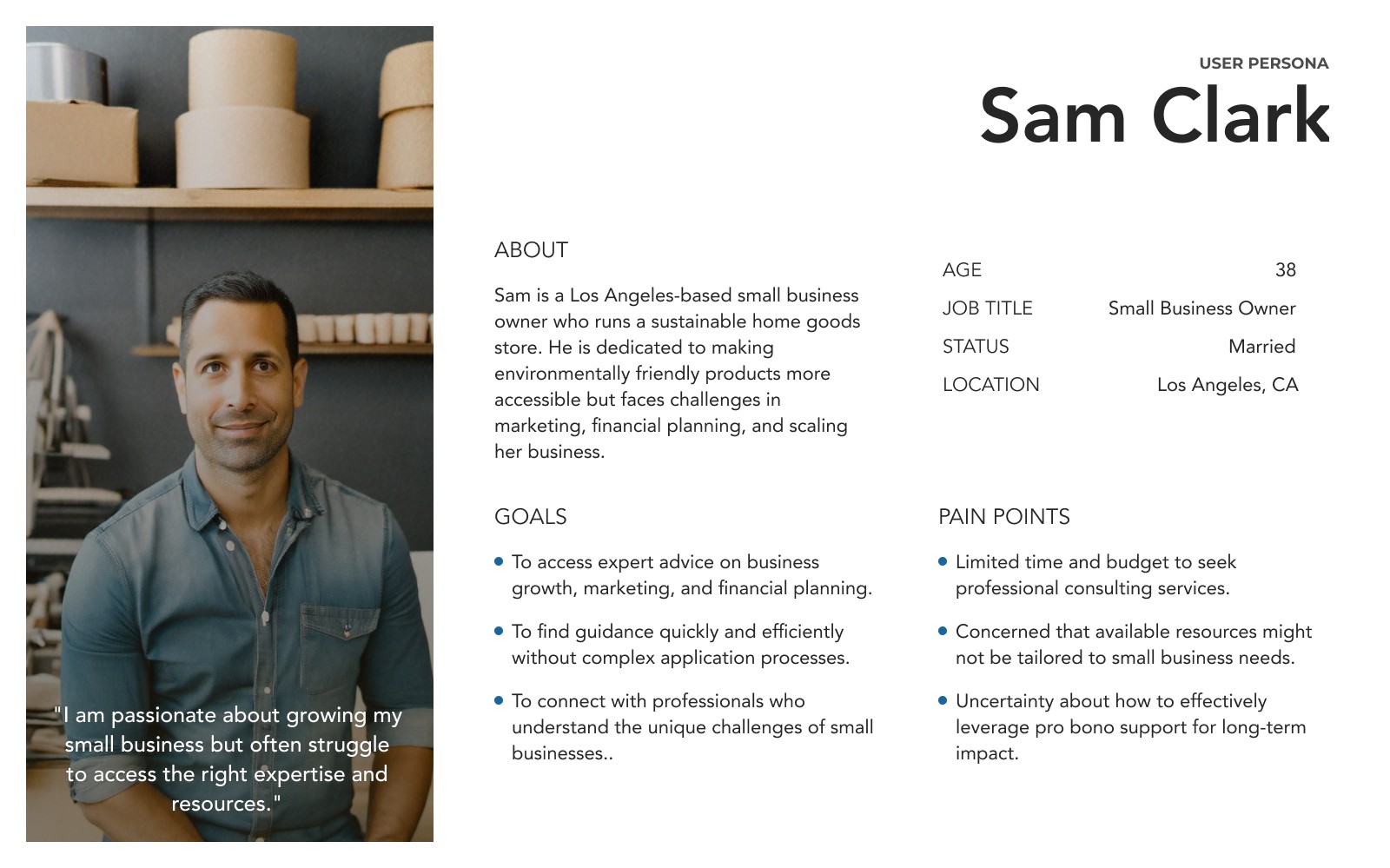
We already had a detailed volunteer persona. Based on our research and small business demographic data, I created a new persona for Small Business Owners, mapping their specific needs, challenges, and expectations when using a pro bono platform for the first time.
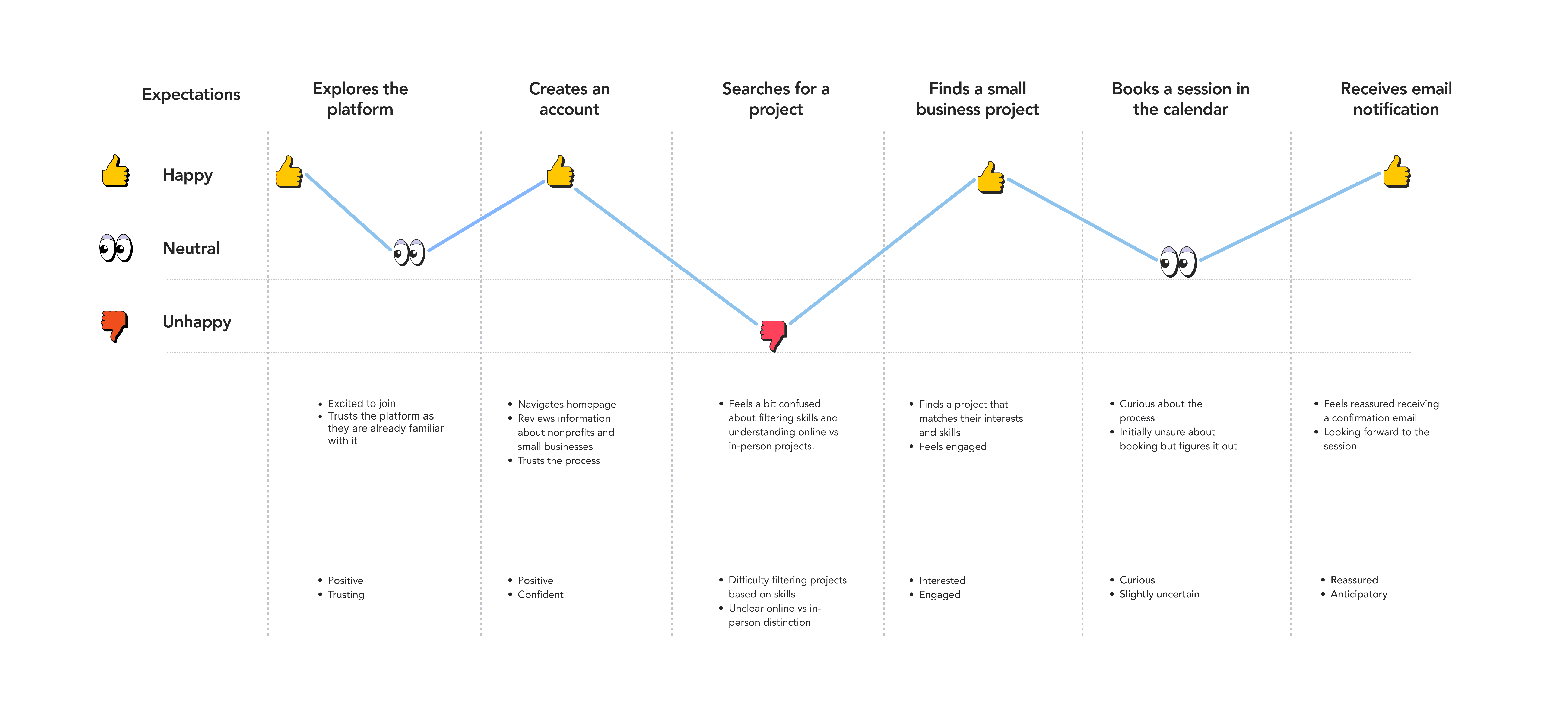
I then built a User Journey Map for the volunteer experience, tracing the full path from account creation to project engagement. Through research synthesis, I identified specific pain points, emotional moments, and decision points where the design needed to provide clarity and confidence.
Cross-Functional Collaboration
With user insights in hand, I engaged with key teams: Product, Engineering, and Marketing to align on implementation. Given our constraints, we needed a low-effort, high-impact approach, so we explored how to leverage existing infrastructure.
Design
For the design process, I focused on reusing existing components and interaction patterns to streamline implementation and reduce engineering effort. The platform already had a structured system in place for nonprofits to apply for support, and I recognized that small businesses followed a similar yet slightly distinct flow. By adapting this existing framework to accommodate small business needs, I was able to build the new experience using modular elements, ensuring consistency while minimizing the need for custom development.
Leveraging the Design System
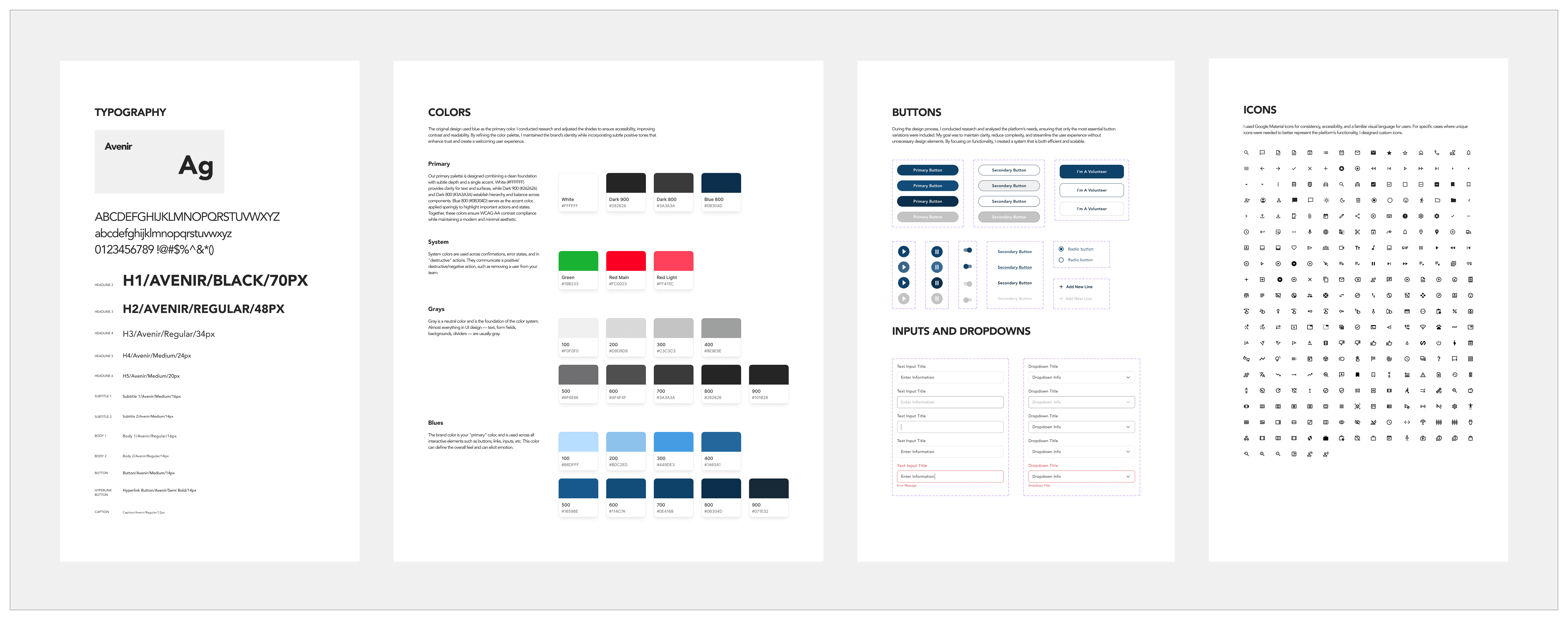
Prior to this project, I had worked on developing Taproot’s design system, which became a critical asset for this initiative. While working on the Design System, I conducted research and identified that only the essential elements were necessary for an efficient design system. Instead of overcomplicating, I focused on building a streamlined, scalable system that simplifies development and enhances consistency.
Wireflows
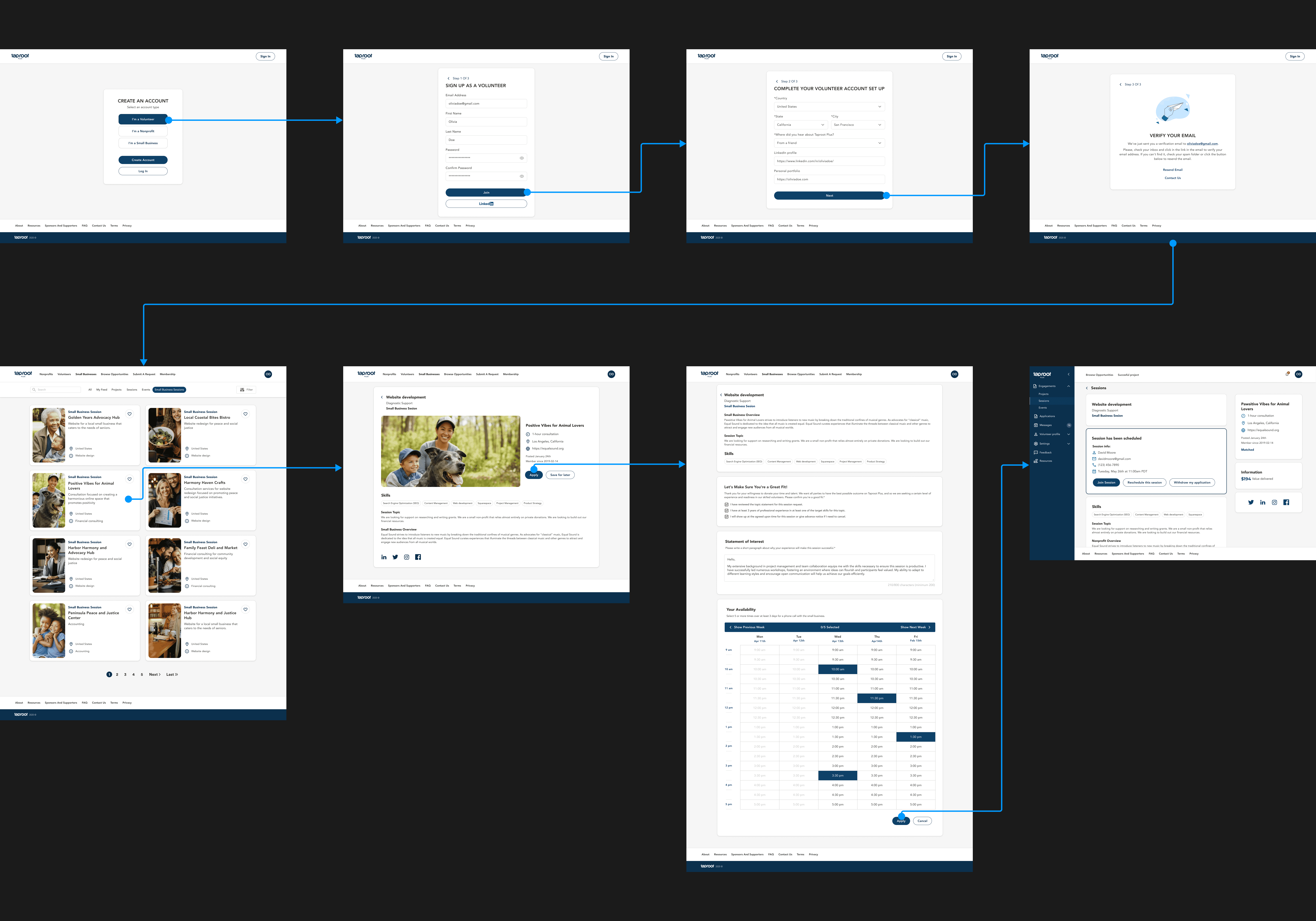
Traditional flowcharts were too abstract. Raw wireframes lacked context. I created wireflows — a combination of wireframes and user flow charts, that gave cross-functional teams with different mindsets an intuitive understanding of how the full experience connected. This became the primary alignment tool for the project.
FINAL DESIGN
complete small business experience
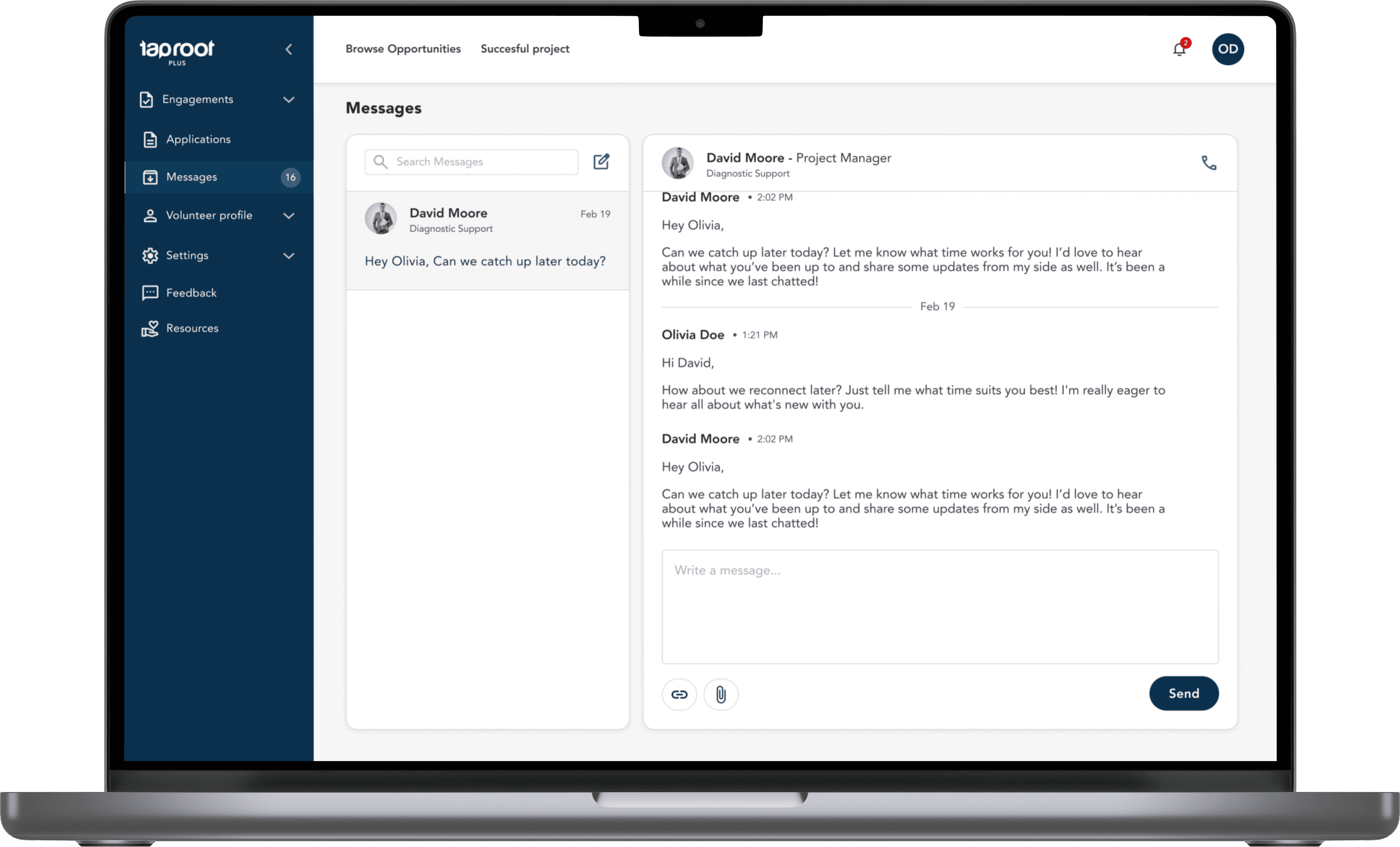
I designed the full product direction: small business browsing and discovery, project detail pages, volunteer application and booking flows, eligibility verification, scheduling with calendar integration, and user dashboards with messaging, session management, and application tracking.

Sign Up as Volunteer
Users start on the homepage, where a dedicated section and an update to the “How it works” flow explain the small business experience. From there, they move through the standard sign-up process, selecting their account type.
At the final step, the email verification screen displays the entered email for confirmation. If needed, users can resend the email or contact support, ensuring a smooth and recoverable onboarding experience.

Submit application and book a call
Users begin by entering their skills, which are used to match them with relevant projects.
A short welcome tour introduces the platform and explains available opportunities, including a dedicated section for small businesses and what that means.
Users can then browse projects, select one, and apply by submitting their information.
REFLECTION
What I learned and what I'd do differently
Infrastructure investment pays off under pressure
The design system and user flowsI built months earlier, as what seemed like a separate initiative, became the critical enabler for shipping a high-stakes product under a tight timeline. This reinforced my belief that building design infrastructure is never wasted effort.
Research resolves organizational doubt
The team's initial skepticism wasn't irrational, it reflected real concerns about mission, users, and risk. User research didn't just inform the design; it gave the organization the confidence to move forward. Research was the bridge between a good idea and an investable product.
What I'd refine: Measuring what matters from day one
If I approached this project again, I would define and implement success rate metrics before launch, not after. Without clear baselines for volunteer engagement, small business satisfaction, and session completion rates, the team had limited ability to iterate with precision post-launch. I'd also invest more in the first-time onboarding experience for small business users and clarify project selection for volunteers to reduce initial confusion.
More Projects
OUTCOME
The product launched, the $300,000 investment was secured, and hundreds of small businesses gained access to free professional expertise during the peak of the COVID-19 crisis, shaping Taproot's long-term direction toward serving small businesses alongside nonprofits.
CONTEXT
The Opportunity
Small businesses make up 99% of all businesses in the U.S. In 2020, nearly half faced existential threats from COVID-19. Many needed expert guidance in financial planning, marketing, and digital transformation, but hiring consultants wasn't an option.
Meanwhile, Taproot Foundation, a national nonprofit operating Taproot Plus, a pro bono platform connecting skilled professionals with organizations in need, had an opportunity to secure a $300,000 investment if it could expand the platform to serve small businesses, not just nonprofits.
This meant designing an entirely new product direction on top of existing infrastructure. Not a feature. Not an iteration. A fundamental expansion of what the platform was for, representing nearly one-third of the entire product.
PROBLEM STATEMENT
Small businesses couldn't access professional expertise. Skilled volunteers were eager to help. No bridge existed between them.
How might we bridge this gap without disrupting the existing nonprofit support model, and without alienating the volunteer community that made the platform work?
Research
APPROACH
Research first. Build trust. Then design.
Before designing a single screen, I needed to understand whether the people who powered the platform, the volunteers, would actually support this expansion
01
Research & Validation
~30 user surveys and 15 interviews with volunteers, nonprofit partners, and corporate clients to validate the expansion direction
02
Cross-Functional Alignment
Engaged Product, Engineering, and Marketing to align on a low-effort, high-impact approach leveraging existing infrastructure.
03
Design & Prototyping
Wireflows, mockups, and prototypes built on the design system I created months earlier, accelerating delivery without sacrificing quality.
04
Executive Buy-In & Launch
Presented the product direction to the COO and VP of Marketing. Secured investment. Launched.
USER RESEARCH
Volunteers said yes, with conditions.
The research surfaced a nuanced picture. Volunteers were open to supporting small businesses, but they had specific trust and transparency requirements that would need to be addressed in the product design.
01
Clear Separation Required
Volunteers did not want small business projects mixed with nonprofit projects. They needed to feel that supporting a business wasn't coming at the expense of a nonprofit that genuinely needed help.
02
Eligibility Transparency
Volunteers wanted to know exactly which small businesses would qualify, and how financial need would be assessed. Without this, trust would erode.
03
Mission Trust Intact
Despite reservations, volunteers expressed trust in Taproot's ability to handle the expansion responsibly, a signal that the direction had social license if executed thoughtfully.
FROM INSIGHT TO DECISION
Every major design decision traced back to a specific research finding.
USER CONCERN
"Don't mix small businesses with nonprofits."
DESIGN RESPONSE
Designed a dedicated landing page for small business projects, completely separated from nonprofit listings, ensuring clear differentiation while maintaining a seamless experience within the platform.
USER CONCERN
"How do I know these businesses actually need help?"
DESIGN RESPONSE
Built detailed eligibility criteria directly into the product, surfacing exactly which types of businesses qualified and why, with transparent financial need requirements. Volunteers could verify before committing.
TEAM CONSTRAINT
"We can't build an entirely new product from scratch."
DESIGN RESPONSE
Adapted the existing nonprofit application flow, modular components from the design system I had built months earlier, ensuring consistency, reducing engineering effort, and accelerating delivery.
PROCESS
Understanding the new user
We already had a detailed volunteer persona. Based on our research and small business demographic data, I created a new persona for Small Business Owners, mapping their specific needs, challenges, and expectations when using a pro bono platform for the first time.
I then built a User Journey Map for the volunteer experience, tracing the full path from account creation to project engagement. Through research synthesis, I identified specific pain points, emotional moments, and decision points where the design needed to provide clarity and confidence.
Cross-Functional Collaboration
With user insights in hand, I engaged with key teams: Product, Engineering, and Marketing to align on implementation. Given our constraints, we needed a low-effort, high-impact approach, so we explored how to leverage existing infrastructure.
Design
For the design process, I focused on reusing existing components and interaction patterns to streamline implementation and reduce engineering effort. The platform already had a structured system in place for nonprofits to apply for support, and I recognized that small businesses followed a similar yet slightly distinct flow. By adapting this existing framework to accommodate small business needs, I was able to build the new experience using modular elements, ensuring consistency while minimizing the need for custom development.
Leveraging the Design System
Prior to this project, I had worked on developing Taproot’s design system, which became a critical asset for this initiative. While working on the Design System, I conducted research and identified that only the essential elements were necessary for an efficient design system. Instead of overcomplicating, I focused on building a streamlined, scalable system that simplifies development and enhances consistency.
Wireflows
Traditional flowcharts were too abstract. Raw wireframes lacked context. I created wireflows — a combination of wireframes and user flow charts, that gave cross-functional teams with different mindsets an intuitive understanding of how the full experience connected. This became the primary alignment tool for the project.
FINAL DESIGN
complete small business experience
I designed the full product direction: small business browsing and discovery, project detail pages, volunteer application and booking flows, eligibility verification, scheduling with calendar integration, and user dashboards with messaging, session management, and application tracking.
Sign Up as Volunteer
Users start on the homepage, where a dedicated section and an update to the “How it works” flow explain the small business experience. From there, they move through the standard sign-up process, selecting their account type.
At the final step, the email verification screen displays the entered email for confirmation. If needed, users can resend the email or contact support, ensuring a smooth and recoverable onboarding experience.
Submit application and book a call
Users begin by entering their skills, which are used to match them with relevant projects.
A short welcome tour introduces the platform and explains available opportunities, including a dedicated section for small businesses and what that means.
Users can then browse projects, select one, and apply by submitting their information.
REFLECTION
What I learned and what I'd do differently
Infrastructure investment pays off under pressure
The design system and user flowsI built months earlier, as what seemed like a separate initiative, became the critical enabler for shipping a high-stakes product under a tight timeline. This reinforced my belief that building design infrastructure is never wasted effort.
Research resolves organizational doubt
The team's initial skepticism wasn't irrational, it reflected real concerns about mission, users, and risk. User research didn't just inform the design; it gave the organization the confidence to move forward. Research was the bridge between a good idea and an investable product.
What I'd refine: Measuring what matters from day one
If I approached this project again, I would define and implement success rate metrics before launch, not after. Without clear baselines for volunteer engagement, small business satisfaction, and session completion rates, the team had limited ability to iterate with precision post-launch. I'd also invest more in the first-time onboarding experience for small business users and clarify project selection for volunteers to reduce initial confusion.
More Projects
OUTCOME
The product launched, the $300,000 investment was secured, and hundreds of small businesses gained access to free professional expertise during the peak of the COVID-19 crisis, shaping Taproot's long-term direction toward serving small businesses alongside nonprofits.
CONTEXT
The Opportunity
Small businesses make up 99% of all businesses in the U.S. In 2020, nearly half faced existential threats from COVID-19. Many needed expert guidance in financial planning, marketing, and digital transformation, but hiring consultants wasn't an option.
Meanwhile, Taproot Foundation, a national nonprofit operating Taproot Plus, a pro bono platform connecting skilled professionals with organizations in need, had an opportunity to secure a $300,000 investment if it could expand the platform to serve small businesses, not just nonprofits.
This meant designing an entirely new product direction on top of existing infrastructure. Not a feature. Not an iteration. A fundamental expansion of what the platform was for, representing nearly one-third of the entire product.
PROBLEM STATEMENT
Small businesses couldn't access professional expertise. Skilled volunteers were eager to help. No bridge existed between them.
How might we bridge this gap without disrupting the existing nonprofit support model, and without alienating the volunteer community that made the platform work?
Research
APPROACH
Research first. Build trust. Then design.
Before designing a single screen, I needed to understand whether the people who powered the platform, the volunteers, would actually support this expansion
01
Research & Validation
~30 user surveys and 15 interviews with volunteers, nonprofit partners, and corporate clients to validate the expansion direction
02
Cross-Functional Alignment
Engaged Product, Engineering, and Marketing to align on a low-effort, high-impact approach leveraging existing infrastructure.
03
Design & Prototyping
Wireflows, mockups, and prototypes built on the design system I created months earlier, accelerating delivery without sacrificing quality.
04
Executive Buy-In & Launch
Presented the product direction to the COO and VP of Marketing. Secured investment. Launched.
USER RESEARCH
Volunteers said yes, with conditions.
The research surfaced a nuanced picture. Volunteers were open to supporting small businesses, but they had specific trust and transparency requirements that would need to be addressed in the product design.
01
Clear Separation Required
Volunteers did not want small business projects mixed with nonprofit projects. They needed to feel that supporting a business wasn't coming at the expense of a nonprofit that genuinely needed help.
02
Eligibility Transparency
Volunteers wanted to know exactly which small businesses would qualify, and how financial need would be assessed. Without this, trust would erode.
03
Mission Trust Intact
Despite reservations, volunteers expressed trust in Taproot's ability to handle the expansion responsibly, a signal that the direction had social license if executed thoughtfully.
FROM INSIGHT TO DECISION
Every major design decision traced back to a specific research finding.
USER CONCERN
"Don't mix small businesses with nonprofits."
DESIGN RESPONSE
Designed a dedicated landing page for small business projects, completely separated from nonprofit listings, ensuring clear differentiation while maintaining a seamless experience within the platform.
USER CONCERN
"How do I know these businesses actually need help?"
DESIGN RESPONSE
Built detailed eligibility criteria directly into the product, surfacing exactly which types of businesses qualified and why, with transparent financial need requirements. Volunteers could verify before committing.
TEAM CONSTRAINT
"We can't build an entirely new product from scratch."
DESIGN RESPONSE
Adapted the existing nonprofit application flow, modular components from the design system I had built months earlier, ensuring consistency, reducing engineering effort, and accelerating delivery.
PROCESS
Understanding the new user
We already had a detailed volunteer persona. Based on our research and small business demographic data, I created a new persona for Small Business Owners, mapping their specific needs, challenges, and expectations when using a pro bono platform for the first time.
I then built a User Journey Map for the volunteer experience, tracing the full path from account creation to project engagement. Through research synthesis, I identified specific pain points, emotional moments, and decision points where the design needed to provide clarity and confidence.
Cross-Functional Collaboration
With user insights in hand, I engaged with key teams: Product, Engineering, and Marketing to align on implementation. Given our constraints, we needed a low-effort, high-impact approach, so we explored how to leverage existing infrastructure.
Design
For the design process, I focused on reusing existing components and interaction patterns to streamline implementation and reduce engineering effort. The platform already had a structured system in place for nonprofits to apply for support, and I recognized that small businesses followed a similar yet slightly distinct flow. By adapting this existing framework to accommodate small business needs, I was able to build the new experience using modular elements, ensuring consistency while minimizing the need for custom development.
Leveraging the Design System
Prior to this project, I had worked on developing Taproot’s design system, which became a critical asset for this initiative. While working on the Design System, I conducted research and identified that only the essential elements were necessary for an efficient design system. Instead of overcomplicating, I focused on building a streamlined, scalable system that simplifies development and enhances consistency.
Wireflows
Traditional flowcharts were too abstract. Raw wireframes lacked context. I created wireflows — a combination of wireframes and user flow charts, that gave cross-functional teams with different mindsets an intuitive understanding of how the full experience connected. This became the primary alignment tool for the project.
FINAL DESIGN
complete small business experience
I designed the full product direction: small business browsing and discovery, project detail pages, volunteer application and booking flows, eligibility verification, scheduling with calendar integration, and user dashboards with messaging, session management, and application tracking.
Sign Up as Volunteer
Users start on the homepage, where a dedicated section and an update to the “How it works” flow explain the small business experience. From there, they move through the standard sign-up process, selecting their account type.
At the final step, the email verification screen displays the entered email for confirmation. If needed, users can resend the email or contact support, ensuring a smooth and recoverable onboarding experience.
Submit application and book a call
Users begin by entering their skills, which are used to match them with relevant projects.
A short welcome tour introduces the platform and explains available opportunities, including a dedicated section for small businesses and what that means.
Users can then browse projects, select one, and apply by submitting their information.
REFLECTION
What I learned and what I'd do differently
Infrastructure investment pays off under pressure
The design system and user flowsI built months earlier, as what seemed like a separate initiative, became the critical enabler for shipping a high-stakes product under a tight timeline. This reinforced my belief that building design infrastructure is never wasted effort.
Research resolves organizational doubt
The team's initial skepticism wasn't irrational, it reflected real concerns about mission, users, and risk. User research didn't just inform the design; it gave the organization the confidence to move forward. Research was the bridge between a good idea and an investable product.
What I'd refine: Measuring what matters from day one
If I approached this project again, I would define and implement success rate metrics before launch, not after. Without clear baselines for volunteer engagement, small business satisfaction, and session completion rates, the team had limited ability to iterate with precision post-launch. I'd also invest more in the first-time onboarding experience for small business users and clarify project selection for volunteers to reduce initial confusion.